About the Science Fair
The Zimbabwe Science Fair (ZSF) is a national platform for discovering, nurturing and celebrating the next generation of scientists, engineers, inventors and innovators. It brings together talented primary school, high school and pre-university students from across Zimbabwe who are investigating questions, developing original ideas and creating solutions to some of society’s most pressing challenges.
The Zimbabwe Science Fair challenges young people to move beyond learning about science and begin doing science. Through independent research, experimentation, engineering design and innovation, students explore how scientific knowledge can be used to improve lives, strengthen communities and create a more sustainable future.

Understanding the Zimbabwe Science Fair
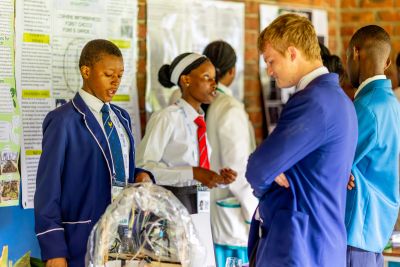
What makes it different?
Research, not just demonstrations
The Zimbabwe Science Fair celebrates students who investigate questions, gather evidence, analyse results and develop conclusions. Projects are expected to demonstrate meaningful student learning and engagement with a scientific or engineering problem—not simply reproduce a familiar experiment or display a model.
Real problems, local solutions
Students are encouraged to investigate challenges that matter to their communities and to Zimbabwe, while recognising that many of these challenges are shared across Africa and the world. A student might investigate ways to improve crop productivity, reduce pollution, develop affordable assistive technologies, conserve water or make energy more accessible.
Creativity backed by evidence
A promising idea is only the beginning. Students learn to test assumptions, compare alternatives, evaluate evidence and refine their approaches. We celebrate both successful results and the insights gained when an experiment does not go as expected.
A national platform for young talent
The fair brings together students from different schools, communities and backgrounds. It provides a platform for their work to be seen, discussed and recognised by scientists, engineers, academics, industry professionals and the wider public.
A pathway to wider opportunities
Outstanding projects may earn recognition through grand awards and special awards, alongside opportunities such as scholarships, internships, prizes and selection to represent Zimbabwe at eligible international science competitions. The fair aims to help students see how their curiosity and research can develop into lifelong learning, further study and meaningful scientific contributions.
Who can participate?
The Zimbabwe Science Fair welcomes eligible primary school and high school students studying in Zimbabwe.
Students may enter projects individually or as part of a team, subject to the competition’s current rules. The fair recognises that scientific talent can emerge at any stage of a young person’s education, and that meaningful research is not limited to students who have access to advanced laboratories.
A project may begin with an observation in a garden, a question about a local environmental problem, a challenge encountered at home or school, or an idea inspired by something a student has read or experienced.
What matters is the student’s willingness to investigate the question carefully, develop an appropriate method, learn from the evidence and explain what the work contributes.
Teachers, research mentors, parents and other supporters play an important role in helping students develop their projects. However, the research must reflect the student’s own understanding, effort and contribution.
Eligibility, team-size limits, age requirements and submission deadlines are published in the official rules for each competition year.
The whole cycle
Participating in the Zimbabwe Science Fair is a journey that begins with curiosity and develops through research, experimentation, communication and evaluation.
1. Discover a question worth investigating
Every research project begins with a question, problem or observation. Students identify something they want to understand, explain, improve or create.
A strong project starts with a clearly defined problem and a research question that can be investigated with the time, resources and methods available to the student.
2. Explore what is already known
Students investigate existing scientific knowledge, examine previous research and identify what remains uncertain or could be improved.
Reading scientific literature and learning from credible sources help students avoid simply repeating existing work and enable them to identify opportunities for new discoveries, better methods or locally relevant applications.
3. Design a research or engineering approach
Students develop a plan for investigating their question or addressing the problem they have identified.
Depending on the project, this may involve designing experiments, collecting field data, conducting surveys, building a prototype, developing software, creating a mathematical model or testing alternative engineering solutions.
The method should be appropriate to the question, clearly documented and designed to produce useful evidence.
4. Conduct the research and test the idea
This is where curiosity becomes investigation. Students carry out their experiments, collect observations, build and test prototypes, record measurements and document their progress.
They learn to work systematically, recognise sources of error, manage uncertainty and adapt their approach when the evidence suggests a different direction.
5. Analyse the evidence and draw conclusions
Students interpret their findings using appropriate scientific, mathematical or engineering methods. They consider whether their results support their original hypothesis or design goals, identify limitations and explain what they have learned.
A project does not need to produce a breakthrough discovery to be valuable. Careful investigation, honest reporting and a clear understanding of the findings are essential parts of meaningful research.
6. Communicate the work
Students prepare their required project documentation and communicate their research through an exhibition display, project presentation and discussion with judges.
They must be able to explain the problem they investigated, why it matters, how they conducted the work, what they discovered and what they would do next.
7. Present, receive feedback and grow
Shortlisted finalists present their work during the fair’s final judging round. Judges examine the quality of the research, the originality of the thinking, the evidence supporting the conclusions and the student’s understanding of the project.
The experience offers students an opportunity to receive expert feedback, learn from other young researchers and discover new possibilities for their work.
What Counts as a Strong Project
A strong project is not necessarily the one with the most expensive equipment, the most elaborate display or the most complicated technology. It is one in which the student demonstrates thoughtful, independent engagement with a meaningful research question or engineering problem.
In evaluating projects, the fair places importance on the qualities that underpin credible scientific and engineering work:
- A clear problem or research question: The student understands what they are investigating and why it matters.
- Sound methodology: The approach is appropriate, systematic and sufficiently detailed to support meaningful investigation.
- Evidence and analysis: The student has collected or generated relevant evidence and can explain how it supports their conclusions.
- Creativity and originality: The work demonstrates inventive thinking, a new approach, a useful improvement or a meaningful contribution to existing knowledge.
- Potential impact: The student can explain how the work might contribute to science, technology, society, the economy or the environment.
- Student ownership: The student understands the work and can explain their personal contribution, including the role of any mentors or collaborators.
- Communication: The project is clearly documented and presented, and the student can respond thoughtfully to questions about the work.
- Reflection and future directions: The student recognises limitations, learns from the results and can identify sensible next steps.
Different kinds of projects require different approaches to evaluation. Experimental science projects and engineering projects, for example, may use different criteria because they address different kinds of questions and goals.
The official judging rubric for each competition year provides the detailed assessment criteria.
Safety, Ethics, & Scientific Integrity
Scientific progress must be accompanied by responsibility.
All projects must comply with the Zimbabwe Science Fair's current rules, applicable safety requirements and relevant ethical standards. Projects involving human participants, hazardous chemicals, potentially hazardous devices, biological agents or other regulated activities may require review and approval before research begins.
Students should consult the official rules and contact the fair organisers when a project may require prior approval. Approval must be obtained at the appropriate stage; students should not assume that a project can be approved retrospectively.
The fair expects students to maintain honest and transparent research records, acknowledge sources, report results accurately and explain the limitations of their findings. Students must not fabricate or manipulate data, misrepresent their contribution or present another person's work as their own.
Appropriate supervision, respect for research participants, responsible treatment of living organisms and protection of the environment are essential considerations throughout a project.
The fair follows the applicable international research rules associated with its affiliation with the Regeneron International Science and Engineering Fair (ISEF), together with its own published requirements.
The Zimbabwe Science Fair Experience
The fair culminates in an event where shortlisted students bring their work together for final judging, exhibition and celebration.
Students prepare their displays and required documentation, explain their projects to judges, answer questions and engage with visitors. The event also gives educators, researchers, industry representatives, families and members of the public an opportunity to encounter the ideas being developed by Zimbabwe's young scientists.
Final judging provides a structured opportunity for experts to evaluate projects and recognise outstanding achievement. Awards and closing activities celebrate the work of the finalists and the wider community that supports them.
Beyond the competition itself, the gathering demonstrates what is possible when schools, families, scientific institutions, businesses and communities invest in young people's capacity to investigate problems and create solutions.
Celebrating Student Achievement
Recognition is an important part of the Zimbabwe Science Fair experience. Awards celebrate the effort, creativity, scientific understanding and potential demonstrated by young researchers.
The competition may include grand awards, special awards and other prizes or opportunities, as announced for each edition. Award categories, eligibility and selection arrangements are governed by the official rules and judging procedures.
Recognition also extends beyond trophies and certificates. Participating students gain experience in research, critical thinking, communication and problem-solving. They learn to defend an idea with evidence, respond to challenging questions and appreciate the work of other researchers.
We also recognise the teachers, mentors, families, judges, volunteers, institutions and sponsors whose support makes student research possible.
Every project presented at the fair represents hours of questioning, testing, learning and persistence. Every student who takes that journey helps strengthen Zimbabwe's culture of scientific discovery.